Before comparing ERP products, the company should define its current and future business requirements, understand the risks hidden within its application spider web, evaluate modern best-practice processes, and create a realistic ERP implementation budget.
HandsFree ERP Tools will do just that.
Many ERP methodologies begin by mapping every current business process in detail.
That sounds logical.
But it can also be dangerous.
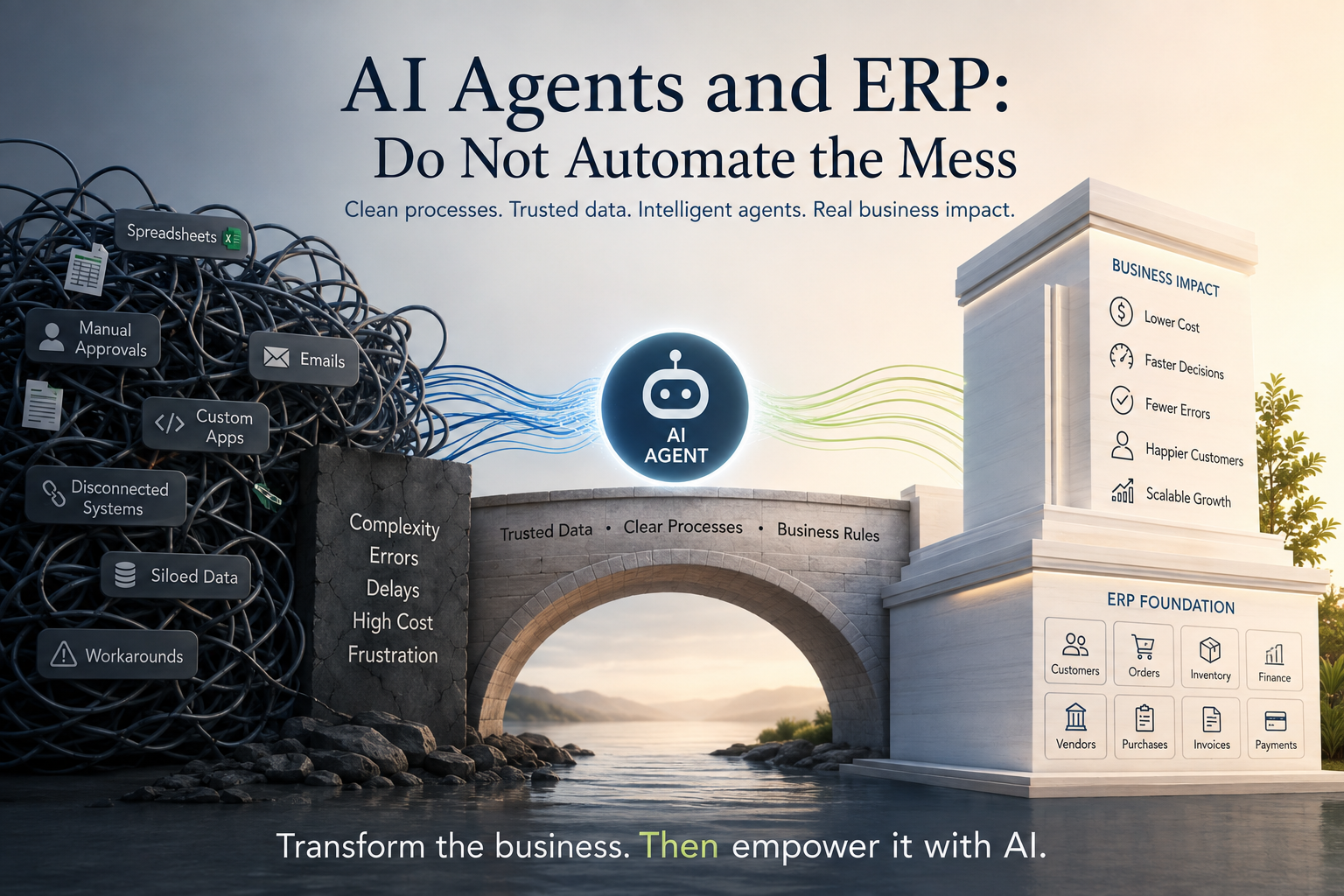
Current processes are often not the processes the business would choose today. They may be the result of years or even decades of compensating for inadequate systems, missing functionality, old customizations, disconnected applications, and manual workarounds.
Employees may perform ten steps because the current ERP cannot support three.
A spreadsheet may exist because reporting never worked properly. A separate application may have been added because the ERP could not support an important business requirement. An integration may move data back and forth simply to keep two aging systems alive. Does this work optimally? Timely? Without errors?
These processes may reflect survival rather than best practice.
Documenting every current step and treating it as a future requirement can lead the company to recreate the same complexity in a new ERP.
The organization spends significant money replacing the technology but keeps the Frankenstein.
It may be newer, cloud-based, and have a nicer dashboard.
But it still has bolts in its neck.
Understand the Spider We Without Recreating It
The company still needs a clear picture of its current application spider web.
That picture helps identify:
- Where critical data currently resides
- Which systems exchange information
- Which applications support essential business functions
- Where custom integrations may create transition risk
- Which historical data must be migrated
- Which systems can be retired
- Where business rules may be hidden
- Which dependencies could disrupt implementation or go-live
This is an application and dependency assessment not an instruction manual for rebuilding the current environment.
The objective is to understand what must be protected, migrated, replaced, redesigned, or eliminated.
Map Business Needs, Not Every Current Workaround
The most important ERP discovery work is defining what the business needs now and in the future.
This includes:
- Critical business capabilities
- Customer and supplier requirements
- Financial and operational controls
- Industry-specific needs
- Reporting and analytics requirements
- Regulatory obligations
- Growth plans
- New products, locations, entities, and channels
- Automation opportunities
- Data and AI requirements
- Future scalability
These needs should be expressed as business requirements rather than copies of existing process steps.
For example, the requirement may be:
Customer-specific pricing must be automatically applied and fully auditable.
That is more useful than documenting twelve manual steps employees currently follow to calculate, approve, enter, check, and correct the price.
The existing twelve-step process may explain the pain.
It should not automatically define the future.
Adopt Best Practices Where They Fit the Business
Modern ERP systems include processes developed from experience across thousands of organizations.
Companies should take advantage of those capabilities rather than immediately customizing the new system to resemble the old one.
The future-state design should begin with:
- The company’s critical business needs
- The future operating model
- Modern ERP best practices
- Genuine competitive differentiators
- Legal, regulatory, and customer obligations
Only requirements that create real business value or address unavoidable complexity should justify significant customization.
“We have always done it this way” is not a business requirement.
It is usually the beginning of a very expensive conversation.
The goal is not to force every company into a generic process. Some organizations have legitimate industry, customer, operational, or competitive requirements that standard functionality cannot fully support.
The goal is to distinguish those important requirements from historical habits and system-generated workarounds.
A Better Discovery Sequence
A stronger ERP discovery process follows this sequence:
1. Define current and future business needs
Identify what the company must accomplish today and what it will need to support over the coming years. We have a state-of-the-art tool to do this in super speed. No consultants coming to meet with you in your conference room and eating your bagels endless portions.
2. Prioritize critical requirements
Separate essential capabilities from preferences, habits, and low-value exceptions. This is where you focus on the demo scenarios when you get to it.
3. Understand the application spider web
Identify systems, data sources, integrations, dependencies, customizations, and transition risks.
4. Evaluate modern best-practice processes
Determine how leading ERP platforms can meet the business need through standard functionality and configuration.
5. Identified genuine gaps
Discover will document where standard best practices do not adequately support the company’s critical requirements.
6. Decide what to retain, redesign, replace, or eliminate
Create an intentional future architecture rather than allowing the old environment to dictate the new one.
This prevents the ERP project from becoming a technical reproduction of yesterday’s problems.
The purpose of ERP modernization is not to preserve every existing process.
It is to build a simpler, more scalable, and more effective way to operate.
Do not pave over the old cow path. Understand where it goes, identify the hazards, and then design a better road. We are with you.
#ERPSelection, #ERPBudgetPlanning, #ERPRequirements, #ERPModernization, #ERPFitGapAnalysis, #ApplicationRationalization, #DataMigration, #CIO, #CFO