This article is part of the series by connecting ERP, data, and AI agents into one practical message: AI should solve real business problems, not automate the application spider web aka Frankenstein or make bad data move faster.
AI agents have quickly become one of the most discussed business technologies.
Executives are asking:
- Where can we use AI agents?
- Which processes should we automate?
- How much value could AI create?
- Can AI help us avoid replacing the ERP?
- Which AI initiative should we start first?
These are important questions.
But there is one question that should come before all of them:
Is the business process and the data supporting it? Ready for an AI agent?
AI agents can monitor activity, analyze information, recommend actions, complete tasks, and coordinate work across business systems.
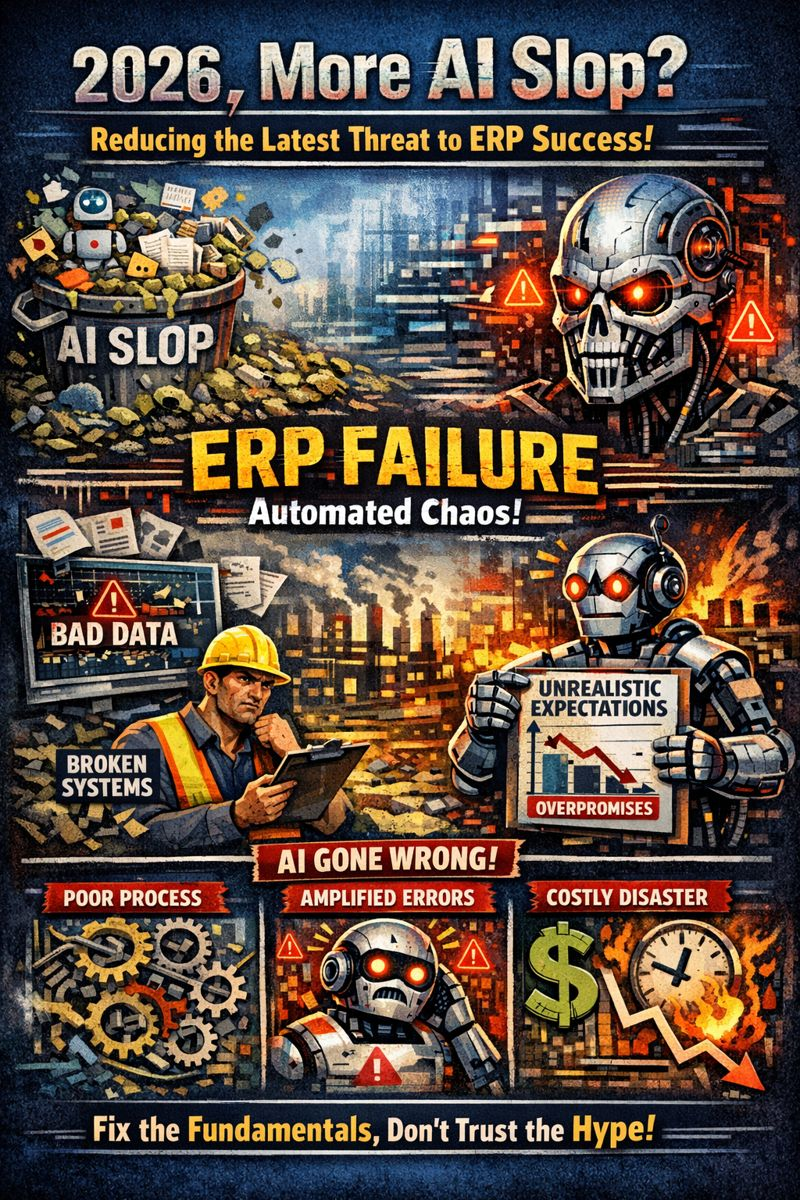
They can also automate poor decisions, unreliable data, unnecessary process steps, and decades-old workarounds.
Only much faster.
AI Agents Are Not a Shortcut Around ERP Problems
Many companies are operating with legacy ERP systems, disconnected applications, custom integrations, spreadsheets, and manual processes.
HandsFree ERP refers to this as the application spider web.
The spider web may include:
- ERP systems
- CRM applications
- Warehouse solutions
- Planning tools
- E-commerce platforms
- EDI systems
- Reporting databases
- Custom applications
- Spreadsheets
- Manual approvals
- Email-based workflows
When business leaders see the potential of AI agents, it is tempting to place automation on top of this environment.
An agent might read an email, update a spreadsheet, check the ERP, review another application, and notify an employee when something goes wrong.
That may produce a short-term improvement.
But it may also preserve the exact complexity the company should be eliminating.
The company has not transformed the process.
It has hired a digital employee to navigate the maze.
Do Not Give Frankenstein an AI Assistant
The same principle that applies to ERP modernization applies to AI.
Do not assume the current process should define the future.
Current processes may have been patched together over many years to compensate for:
- Inadequate ERP functionality
- Missing integrations
- Poor reporting
- Unreliable data
- Manual controls
- Old customizations
- Department-specific applications
- Regulatory or customer changes
- Processes that no longer fit the business
These workarounds may explain why the company wants AI.
They should not automatically determine what the AI agent should do.
Before automating a process, leadership should ask:
- Does this process still need to exist?
- Can the ERP support it through standard functionality?
- Can unnecessary steps be eliminated?
- Is the process consistent across departments?
- Is the underlying data reliable?
- Are the business rules documented?
- Who owns the decision?
- What happens when the agent encounters an exception?
- What level of human approval is required?
Otherwise, the organization may use advanced AI to preserve an outdated operating model.
Frankenstein is still Frankenstein.
He just has Copilot now.
Start With Business Pain, not AI Technology
A common AI mistake is beginning with the technology.
Someone sees an impressive demonstration and asks:
Where can we use this?
A better approach begins with business pain.
For example:
- Where are employees spending the most time on repetitive work?
- Which decisions are delayed because information is difficult to collect?
- Where do errors create financial or customer impact?
- Which processes generate the most exceptions?
- Where are employees copying information between systems?
- Which activities depend on email and spreadsheets?
- Where are customer, vendor, or employee questions repeatedly answered?
- Which processes cannot scale with business growth?
- Where is valuable data available but underused?
The goal is not to deploy the largest number of AI agents.
It is to identify the agents that can produce the highest business return with acceptable risk.
What Is an AI Agent?
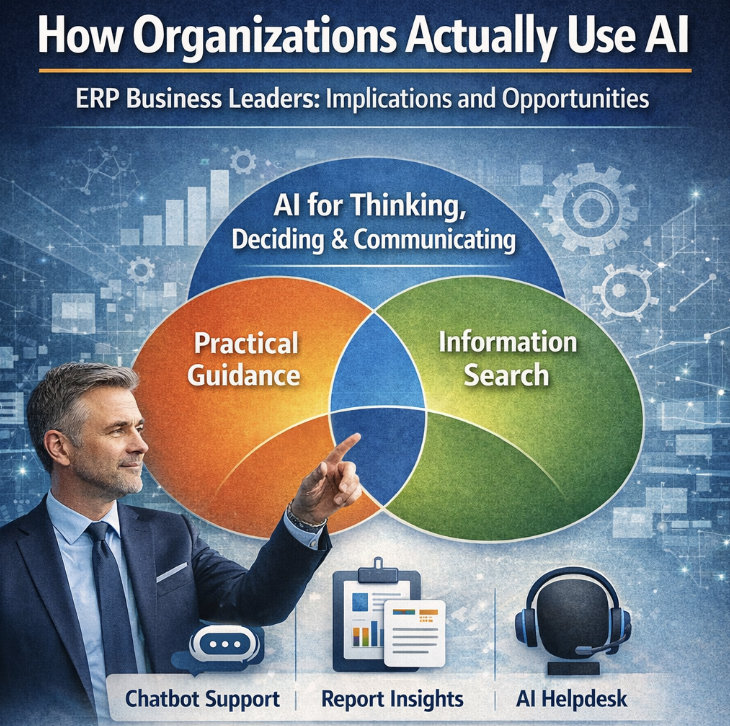
An AI agent is a software-based capability that can interpret information, make decisions within defined boundaries, and take actions toward a business objective.
Unlike a traditional automation that follows a fixed sequence, an AI agent may:
- Interpret unstructured information
- Evaluate context
- Select between possible actions
- Interact with multiple systems
- Request approval
- Learn from outcomes
- Escalate exceptions
- Generate recommendations
- Complete tasks on behalf of a user
An AI agent may support a person, a department, or an end-to-end business process.
Examples include agents that:
- Review sales orders for exceptions
- Match invoices to purchase orders and receipts
- Investigate customer deductions
- Monitor inventory risks
- Recommend purchase actions
- Identify overdue accounts
- Prepare management reports
- Answer employee policy questions
- Detect master-data quality issues
- Coordinate customer-service responses
The most valuable AI agents are usually not the most entertaining.
They are the ones quietly removing cost, delay, errors, and frustration from high-volume business processes.
ERP, Data, and AI Agents Must Work Together
AI agents do not operate in isolation.
They depend on business systems, process rules, and data.
The ERP often provides the transactional foundation:
- Customers
- Vendors
- Products
- Inventory
- Orders
- Purchases
- Invoices
- Payments
- Financial transactions
- Operational controls
The data environment provides the context:
- Historical trends
- Reporting information
- External data
- Documents
- Emails
- Forecasts
- Customer interactions
- Policies and procedures
The AI agent uses this information to understand a situation and recommend or perform an action.
This creates a simple dependency:
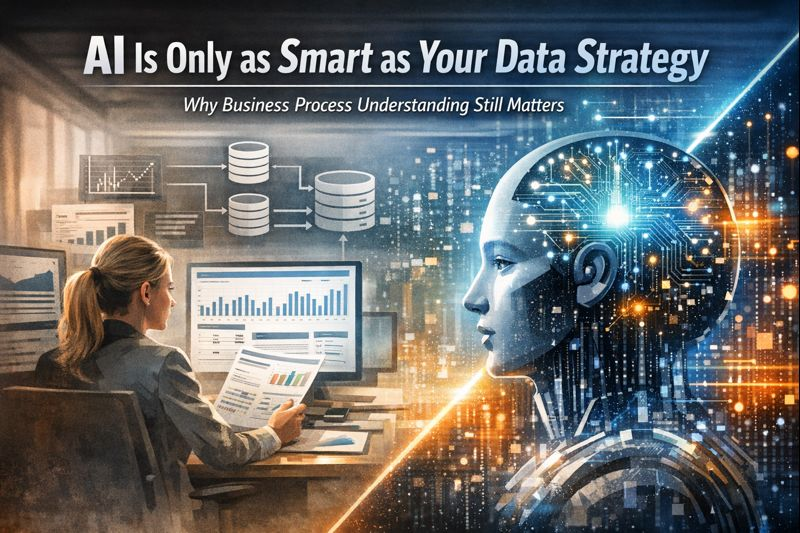
ERP provides the transactions. Data provides the context. AI agents provide the action.
When the ERP environment is fragmented or the data is unreliable, the AI agent must work harder to determine what is true.
Sometimes it cannot.
Bad Data Creates Confidently Bad Automation
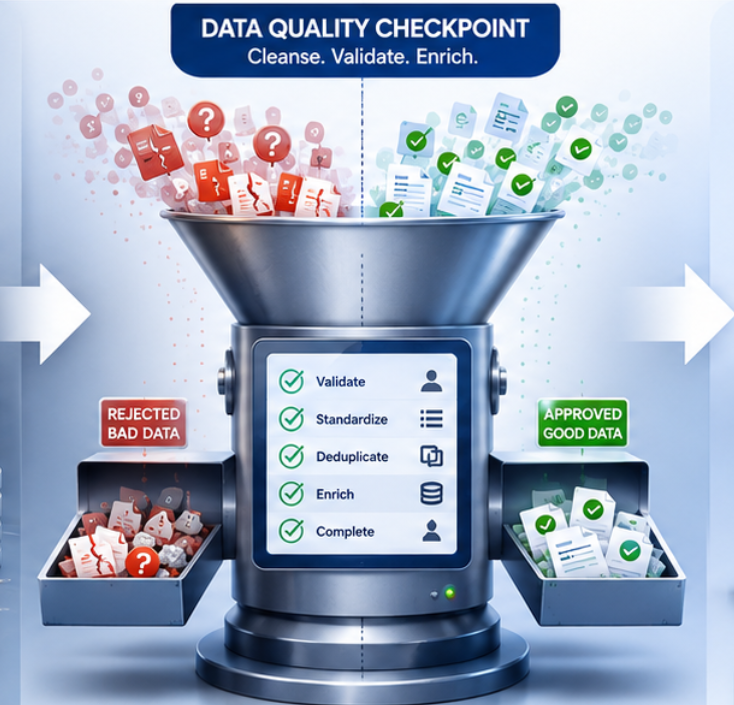
AI agents depend on accurate, complete, consistent, and accessible data.
If customer records are duplicated, an agent may communicate with the wrong contact.
If inventory information is unreliable, it may recommend the wrong purchase quantity.
If pricing rules are hidden in spreadsheets, it may approve an incorrect discount.
If vendor lead times are outdated, it may create unnecessary purchase orders.
If financial dimensions are inconsistent, it may produce misleading management analysis.
The danger is not always that the AI agent fails visibly.
The greater risk is that it completes the wrong action confidently.
Bad data already creates operational problems.
AI can turn those problems into automated operational problems.
That is not scale.
That is confusion with excellent response time.
AI Readiness Begins With Data Readiness
Before deploying an AI agent, companies should evaluate:
- Data accuracy
- Required-field completeness
- Duplicate records
- Master-data ownership
- Source-of-truth decisions
- Data accessibility
- Historical quality
- Integration reliability
- Security classifications
- Governance rules
- Retention policies
- Permission structures
The organization does not need perfect data before it begins using AI.
Perfect data rarely exists.
But the data supporting the agent’s decisions must be reliable enough for the business risk involved.
An agent that recommends draft email responses has a different data-quality requirement than an agent that releases customer orders or approves payments.
The greater the potential impact, the stronger the data and control requirements should be.
Not Every Process Needs an AI Agent
Some processes are better solved through:
- Standard ERP functionality
- Workflow configuration
- Business rules
- Traditional automation
- Robotic process automation
- Better reporting
- System integration
- Process simplification
- Employee training
AI should not be used simply because it is available.
If a fixed rule can solve the problem reliably, a fixed rule may be the better answer.
For example:
If an invoice exceeds $25,000, route it for approval.
That does not require an AI agent.
But an agent may be useful when the task requires interpreting documents, investigating exceptions, evaluating several information sources, or recommending an action based on context.
The best AI strategy uses the simplest technology capable of solving the problem.
Sometimes the most intelligent answer is not AI.
AI will recover from the disappointment.
Seven Signs a Process May Be Ready for an AI Agent
A business process may be a strong AI-agent opportunity when several of these conditions are present:
1. The process consumes significant employee time
Employees spend hours gathering information, reviewing documents, researching issues, or coordinating repetitive tasks.
2. The process includes many exceptions
Traditional automation handles the standard path, but employees must interpret and resolve frequent variations.
3. Information is spread across several sources
Users must search the ERP, email, documents, spreadsheets, and external systems before making a decision.
4. Delays create financial or customer impact
Slow decisions affect revenue, cash flow, inventory, service levels, or compliance.
5. The decision follows understandable business logic
The organization can describe the factors, rules, thresholds, and risks that should influence the outcome.
6. Outcomes can be measured
The company can track time saved, errors reduced, cash recovered, costs avoided, or service levels improved.
7. Human oversight can be defined
The business knows when the agent may act independently and when a person must review or approve the decision.
These conditions do not guarantee that an AI agent should be deployed.
They indicate that the opportunity deserves closer evaluation.
Which business problem should we solve and is the process, ERP, and data foundation ready?
That is where a successful AI-agent strategy begins.
Preferably before someone gives the bot access to the spreadsheet nobody understands.
Find Your Highest-Value AI-Agent Opportunities
Before investing in AI tools, identify where AI agents can create the greatest measurable return.
The HandsFree ERP
AI Agent Opportunity Snapshot evaluates business pain points, process readiness, data quality, ERP dependencies, potential value, and implementation complexity.
The result is a prioritized roadmap showing which AI agents to pursue first, what must be fixed before implementation, and where ERP or data improvements may be the better starting point.
Start with the business problem. Not the bot.